
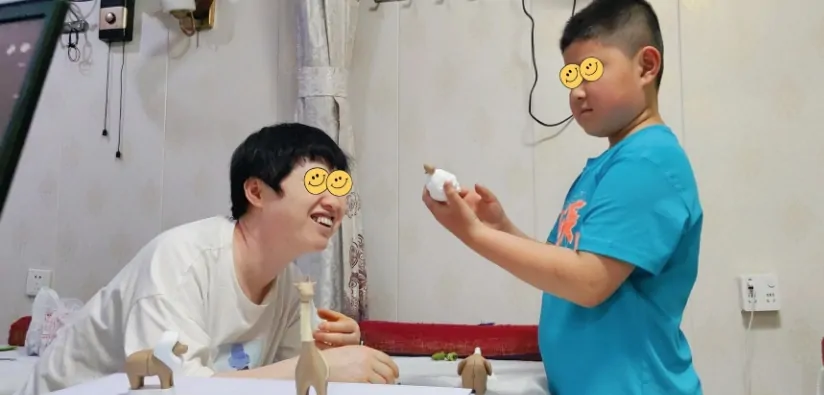
Visually impaired parents encounter significant barriers in parent-child interactions due to sensory asymmetry and insufficient assistive tools, leading to imbalanced roles and weakened emotional bonds. This paper presents Haptic Zoo, a modular multi-sensory toy system designed to bridge tactile-auditory collaboration between visually impaired parents and sighted children. Through semi-structured interviews with 20 families and user experiments involving 19 families, we identified key design goals: enhancing accessibility via tactile markers and audio feedback, integrating multi-sensory engagement, and fostering role-balanced collaboration. The prototype employs 3D-printed textured components, magnetic connections with audible clicks, and RFID-triggered audio rewards. Quantitative results from adapted usability scales (UPEQ) and behavioral coding (IOS) demonstrated high usability and emotional bonding. Qualitative findings revealed improved collaborative dynamics, mutual empowerment through sensory complementarity, and reduced frustration. Haptic Zoo transforms sensory asymmetry into a collaborative advantage, offering design guidelines for inclusive, role-based toys. This study contributes to inclusive HCI research by addressing the overlooked needs of visually impaired parents and offering design guidelines for role-based collaborative toys.
Abstract
Loading graph...
100%
Project
Tag
Area