
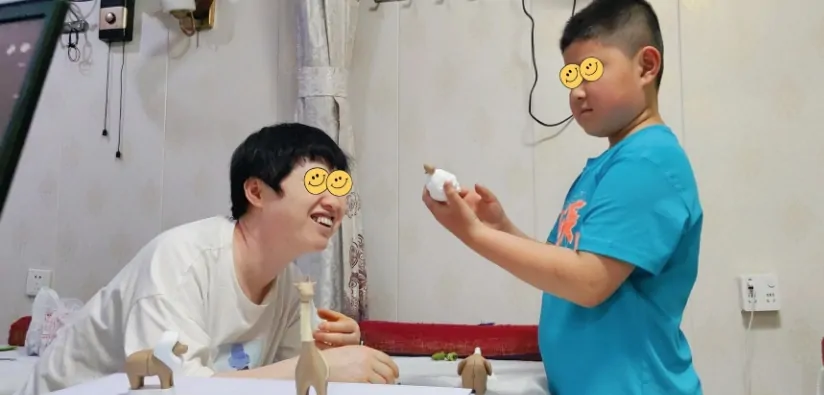
Visually impaired parents encounter significant barriers in parent-child interactions due to sensory asymmetry and insufficient assistive tools, leading to imbalanced roles and weakened emotional bonds. This paper presents Haptic Zoo, a modular multi-sensory toy system designed to bridge tactile-auditory collaboration between visually impaired parents and sighted children. Through semi-structured interviews with 20 families and user experiments involving 19 families, we identified key design goals: enhancing accessibility via tactile markers and audio feedback, integrating multi-sensory engagement, and fostering role-balanced collaboration. The prototype employs 3D-printed textured components, magnetic connections with audible clicks, and RFID-triggered audio rewards. Quantitative results from adapted usability scales (UPEQ) and behavioral coding (IOS) demonstrated high usability and emotional bonding. Qualitative findings revealed improved collaborative dynamics, mutual empowerment through sensory complementarity, and reduced frustration. Haptic Zoo transforms sensory asymmetry into a collaborative advantage, offering design guidelines for inclusive, role-based toys. This study contributes to inclusive HCI research by addressing the overlooked needs of visually impaired parents and offering design guidelines for role-based collaborative toys.
Background
Visually impaired parents often struggle to join everyday play on equal terms. Most commercial toys rely heavily on vision, small parts, and fast visual confirmation, which makes it easy for sighted children to dominate the activity while parents become observers. Haptic Zoo reframes this asymmetry as an opportunity for collaboration rather than a deficit to be compensated for.
Research Opportunity
Through semi-structured interviews with 20 families, we identified three recurring issues:
- Existing toys lacked tactile or audio cues, making independent participation difficult for visually impaired parents.
- Children often took over the play process for efficiency, which conflicted with parents’ expectation of equal collaboration.
- Families consistently asked for tactile guidance, audio confirmation, and clearer role division.
Design Concept
Haptic Zoo is a modular multi-sensory toy set for visually impaired parents and sighted children. The system includes five animals and a contour-style habitat map. Each animal is split into 6-9 3D-printed PLA modules. Sighted children assemble the outline pieces, while visually impaired parents identify textured feature pieces such as the lion’s mane, the elephant’s trunk, or the sheep’s wool through raised lines, grooves, and edge differences.
Interaction Details
The interaction is designed around sensory complementarity. Polarity-matched magnets help parts snap into place and produce an audible click, giving immediate confirmation during assembly. Once an animal is completed and placed on the themed mat, an embedded RFID tag is detected by an RC522 module beneath the correct location. An Arduino UNO and DFPlayer Mini then trigger encouraging voice feedback and animal sounds. When all animals are completed, the system plays a final summary message, turning completion into a shared ritual.
User Study
We evaluated Haptic Zoo with 19 families in a 45-minute study combining adapted UPEQ questionnaires, IOS behavioral coding, and semi-structured interviews. Results showed high usability and strong emotional bonding. Parent-rated overall satisfaction reached 4.91 / 5, while the emotional and relational connection dimension reached 4.59 / 5. Children reported 4.77 / 5 on emotional connection and 4.84 / 5 on educational and cognitive value. Observational coding also showed strong task engagement and effective sensory collaboration.
Takeaway
Haptic Zoo suggests that inclusive play does not need to erase difference. Instead, well-designed tactile-auditory cues, role-based mechanics, and shared feedback can transform sensory asymmetry into mutual support, trust, and joy. The project offers a concrete design case for accessible toys, family-centered HCI, and collaborative multi-sensory interaction.