
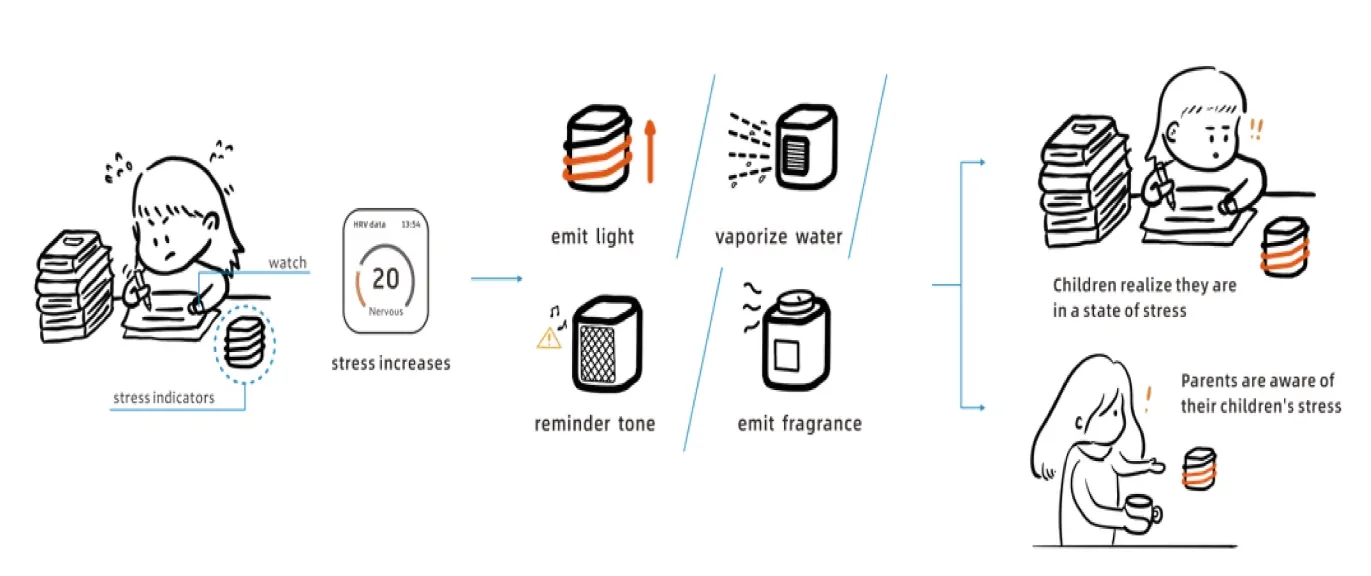
Elementary school students in China are facing learning stress and are at the stage of developing cognitive strategies for constructive stress management between the ages of 6-12. Cognitive flexibility is essential to cope with stress and anxiety in daily life, making stress management necessary. Self-awareness of stress in children can aid stress management, and visualizing stress can effectively enhance children's understanding of their own stress levels. In this paper, four different types of stress indicators were designed to characterize children's learning stress. The study explores how children and their parents perceive learning stress through these ambient indicators. The results suggest that children respond more positively to scent and vaporization during the learning process, while parents prefer light-based alerts. Both children's awareness of their own stress and parents' awareness of children's stress show potential to support stress regulation in learning contexts.
Background
Children in home learning environments often experience stress that is real but difficult to articulate. For elementary-school students, stress is still an abstract concept: they may feel discomfort, distraction, or frustration, yet lack the vocabulary and self-awareness needed to explain what is happening. Parents, meanwhile, usually infer stress from visible behavior alone, which can lead to misjudgment, delayed support, or even additional pressure during tutoring.
Stress Management for Children investigates how stress can be made perceivable in a gentler and more child-centered way. Instead of using a dashboard or a screen-heavy interface, the project explores ambient multisensory cues that stay close to the learning environment itself. The goal is not only to detect stress, but to help children become aware of it and help parents respond with better timing and understanding.
Design Objective
The project is built around a simple but important question: how can an invisible internal state be translated into something children and parents can both notice, understand, and use?
To answer that, the research proposed four stress indicators for home learning scenarios:
lightvaporizationfragrancetone
Each indicator represents stress through a different sensory pathway and a different level of intrusiveness. This comparison is important because stress awareness during learning is not just a technical detection problem. It is also an interaction-design problem about how much interruption is acceptable, what kind of signal feels supportive, and whether the same cue works equally well for children and parents.
System Concept
The system combines physiological sensing, children’s self-report, and environmental feedback. A health tracker detects stress-related changes, while the child also provides a simplified self-evaluation to improve interpretation accuracy. Once stress is detected, the system activates ambient feedback devices for both the child and the parent through two synchronized sets of prototypes.
This dual-end setup matters because the project treats stress management as a shared process rather than a private metric. The child can notice and adjust their own state during learning, while the parent can better understand when support, encouragement, or a pause may be needed.
Implementation Details
The prototype system was assembled from lightweight and accessible components, including Arduino Nano, Raspberry Pi, WS2812B LEDs, an HC-06 Bluetooth Module, a 5V 4000 mAh battery, Arduino 5V humidifier mist modules, ultrasonic mist maker transducers, a diffuser, and a speaker.
The feedback logic was deliberately concrete:
Light: higher stress makes the color warmer and increases the number of illuminated LEDs.Vaporization: higher stress increases the amount and intensity of mist output.Fragrance: the scent device is triggered when stress exceeds the average level.Tone: audio feedback is triggered when stress exceeds the average level.
Rather than presenting exact numbers, the project translates stress into perceivable changes in atmosphere. This makes the feedback easier to understand for children and less dependent on direct interpretation of charts or textual data.
Study Design
The user study involved 23 children and 23 parents in a quiet, private classroom setting. Children wore an Apple Watch, and HRV values were collected before and during the experiment. To create a realistic learning task, each child completed math worksheets matched to their educational level, with questions progressing from easy to difficult.
Each child went through 4 test rounds, one for each stress indicator, and each round lasted 8 minutes. The order of the four devices was randomized to reduce order effects. At the 2-minute and 6-minute marks of every round, two measurements were taken:
- HRV data from the wearable device
- a child-friendly simplified stress scale from
0-100
After the testing sessions, the study continued with qualitative feedback:
- children participated in
10-minutesemi-structured interviews - parents completed a
5-point Likert scale - parents then joined
15-minutesemi-structured interviews
This design made it possible to compare objective physiological signals, children’s self-perception, and parent interpretations within the same learning scenario.
Key Findings
The study found that most children and parents were open to stress visibility, but they did not prefer the same kind of feedback.
Children generally favored slower, less disruptive cues. Their preference order was:
vaporizationfragrancelighttone
Parents preferred clearer and more attention-grabbing reminders. Their order was:
lighttonevaporizationfragrance
This contrast reveals an important design tension. Children wanted cues that blended into the learning environment and did not interrupt concentration. Parents, on the other hand, preferred cues that were obvious enough to notice immediately. The system therefore highlights that stress communication in home learning cannot be designed only for the child or only for the adult; it has to account for both perspectives at once.
The combined HRV and self-evaluation data also suggested that children’s stress often decreased more clearly under their preferred feedback conditions, while more disturbing cues could make stress feel stronger. Most of the time, physiological data and self-report aligned reasonably well, but there were still mismatches, which points to the importance of combining sensing with child-friendly self-expression instead of relying on a single signal source.
Why It Matters
This project shows how children’s stress can be represented through ambient interaction rather than dashboards or explicit numerical displays. By comparing light, vaporization, fragrance, and tone across both children and parents, the work reveals that stress communication in home learning must balance self-awareness, low interruption, and family understanding at the same time.
It also suggests that multisensory feedback can support stress regulation only when the mapping is developmentally appropriate and socially legible. In that sense, the project is not only about sensing stress, but about designing how stress becomes understandable within a parent-involved learning environment.